Saturday, 2 February 2019

Nagaland consultative meeting rejects Citizenship Bill

Nagaland consultative meeting rejects Citizenship Bill

Opposition Naga People's Front and Congress boycotted the meeting.

 
Neiphiu Rio. (File Photo: IANS)
Kohima:  A consultative meeting on Citizenship (Amendment) Bill, 2016, convened by the Nagaland government with civil societies, tribal organisations, political parties, NGOs and student organisations on Thursday unanimously resolved to oppose the Bill and reject its implementation outright in Nagaland.

Opposition Naga People's Front and Congress boycotted the meeting.

The NPF said it decided to boycott the meeting as the Nationalist Democratic Progressive Party-led People's Democratic Alliance government did not oppose the Bill when it was tabled in Lok Sabha on January 8.

The Congress, which was decimated in the Assembly elections, said the meeting is a case of "too little too late" after enough damage was done by the PDA government while "pursuing the BJP-driven agenda".

However, the meeting attended by Chief Minister Neiphiu Rio adopted a five-point resolution and unanimously resolved to oppose the Citizenship Amendment Bill 2016 and outrightly rejected its implementation in Nagaland.

"Nagaland stands in solidarity with the rest of the region in order to safeguard the rights of the indigenous people of the region," the meeting, chaired by chief secretary Temjen Toy and attended by 184 representatives Naga tribe bodies, NGOs and student organisations besides members of various political parties of the state, resolved.

The meeting also resolved that the Nagaland Assembly should discuss and resolve to enforce inner-line permit regulations all over the state including, Dimapur district which is not under the purview of the inner-line permit system.

IANS

India's failing health system hits women hardest

India's failing health system hits women hardest

State-run hospitals often deny services to poor females, leading to unnecessary deaths.

 
File photo.
Srinagar:  The snowy night of Jan. 17 was a long one for 36-year-old Suraiya Bano. The pregnant woman, in labor, had been turned away by three hospitals in India's Jammu and Kashmir state, forcing her to give birth by a roadside.

The baby died a few minutes later in the freezing conditions, her 42-year-old husband Wazir Ahmad said.

Earlier that evening Ahmad had carried his wife on his shoulders along a dark, snow-covered road from their remote Moori hamlet to a hospital three kilometers away. She was complaining of pain.

Doctors asked him to take her to the main Kupwara district hospital and arranged a vehicle. There he was asked to take her to Kashmir's main maternity hospital in the summer state capital Srinagar, 62 kilometers away.

After six long hours travelling to the maternity hospital, doctors conducted some tests before telling the couple to go home, saying the hospital had no space to accommodate Bano.

"But where can we go and what if something happens to my wife?" Ahmad asked the doctors. But hospital staff kicked the couple out.

"In the freezing cold, we spent the night by a roadside. All of a sudden my wife gave birth to the baby, but moments later it died," Ahmad said.

Poor Indian women like Bano being denied health care in state-run facilities remains a big concern, according to Srinagar-based social activist Dilshana Andrabi.

"The rich can afford private nursing homes, but where can the poor go?" she asked.

Andrabi told ucanews.com that recent surveys have highlighted how poor women are on the receiving end of pathetic state-run health services.

The latest study was released on Jan. 22 by Oxfam, a confederation of 20 independent charitable organizations focusing on the alleviation of global poverty. It claimed that the poor are denied health care, exposing them to greater risks of lethal diseases.

"When governments reduce their expenditure on essential public services such as education and health care, women and girls are the first ones to lose out on these services," it said.

Oxfam's executive director Winnie Byanyima says Indian women and girls from lower castes are the hardest hit by growing economic disparity.

She said the life expectancy of a low-caste woman is almost 15 years less than that of an upper-caste woman as high-quality medical care is only available to those who have the money to pay for it.

The experience of 52-year-old Tara Devi, from a peasant family in Uttar Pradesh, is a case in point. Her pregnant daughter died a year ago because the health care facility in her village was not equipped to conduct a birth by caesarean section.

She had to wait with her daughter for hours to get transport to a hospital. "She died on the way along with her baby. There wasn't anyone responsible. We could complain to no one," Devi said.

Marginalized communities

Shamaila Khalil, program coordinator at Oxfam India, told ucanews.com that Dalit women in India die 14.6 years earlier than those of a higher caste. The health system for the poor, especially women from marginalized communities, is a shambles, she said.

"India ranks the third lowest on health on the World Economic Forum's Gender Gap Index. Instead of investing more in strengthening the health system to ensure every woman has the care that she needs, we have seen a reduction in the health budget for villages, including a dire cut for reproductive and child health," Khalil said.

India cannot expect to ensure good health care for every woman by spending only 1,112 rupees (US$15) per head per annum, she added.

More needs to be done to provide psychosocial support and care, particularly in cases related to mental health and gender-based violence, Khalil told ucanews.com.

Archbishop Felix Toppo of Ranchi says the Indian government has been doing little to address the emerging health care crisis.

The prelate, who is also a member of the Catholic Bishops' Conference in India health care commission, told ucanews.com that the government follows a capitalist policy that ignores the poor.

"Corporate houses are being built with full vigor. The country needs a comprehensive health service for the poor, especially women who are falling prey to the negligent attitude of the government," Archbishop Toppo said.

India's is the world's sixth-largest economy with gross domestic product (GDP) of US$2.848 trillion and the third largest by purchasing power parity. However, poverty is so rampant that about 200 million of its 1.2 billion people have no income for a full meal a day, studies show.

Government spending on the welfare of the poor is also too low. For example, according to the latest National Health Profile, India spends a little over one percent of its GDP on health care, which is amongst the lowest in the world.

According to the annual report of the state-run Central Bureau of Health Intelligence, India spends less than Bhutan (2.5 percent), Sri Lanka (1.6 percent) and Nepal (1.1 percent) on health care.

When the poor are neglected, women and girls are the most vulnerable because of Indian society's general preference for boys to lead families to the next generation, studies show.

Women's disproportionate poverty, low socioeconomic status, gender discrimination and reproductive role not only expose them to diseases but also limit their access to health services, according to a 2018 research article written by Raju Kowsalya and Shanmugam Manoharan of Annamalai University.

Domestic violence, rape and sexual abuse affect women's productivity, autonomy, quality of life and physical and mental well-being, the article said.

Source: UCAN

Delhi court rejects plea for probe into clergy abuse claims

Delhi court rejects plea for probe into clergy abuse claims

Public interest litigation argued state investigations needed because church authorities ignored sex abuse complaints.

 
Catholics celebrate the feast of Christ the King on Nov. 25, 2018, at the Cathedral of Sacred Heart in Delhi Archdiocese. The Delhi High Court has dismissed a plea seeking to establish special teams to investigate claims of sexual abuse by Catholic clergy. (Photo by Bijay Kumar Minj/ucanews.com)
New Delhi:  A high court in India has dismissed a request for special teams to investigate allegations of sexual abuse of children and nuns by Catholic priests.

The Delhi High Court dismissed the public interest litigation of Sanjjiiv Kkumar for the federal and Delhi state governments to create such investigative teams.

The state court of the national capital territory declined on Jan. 29 to entertain the plea, saying it contained no specific incidents on record other than a recent allegation made by a Kerala nun that a bishop sexually abused her, which is still under investigation.

"We'll not look into all this. Dismissed," the two-judge bench of Chief Justice Rajendra Menon and Justice V.K. Rao said.

The plea also wanted the Delhi government to set up a telephone hotline so that victims of clergy sex abuse could seek help.

In his plea, Kkumar also claimed that church authorities ignored allegations of sex attacks on a nun at a Catholic retreat in Delhi despite the nun writing an anonymous letter. Kkumar's source of such information was not mentioned in the plea.

The plea argued that given that church authorities have ignored complaints of clergy sex abuse an investigative system was needed to seek justice for victims.

The case on record that Kkumar's plea referred to is based on a June 2018 police complaint made by a nun which accused Bishop Franco Mulakkal of Jalandhar of rape. The nun has claimed the bishop raped her multiple times between 2014 and 2016 when he visited her convent in Kerala.

The plea claimed that since Bishop Mulakkal was auxiliary bishop of Delhi Archdiocese from 2009-13, there was a "possibility" that he sexually attacked women in Delhi during that period.

Plea refuted as absurd

Father J. Felix, secretary of Delhi Archdiocesan Commission for Ecumenism and Interfaith Dialogue, said the plea and its logic are absurd.

"[It is] highly malicious, it is targeting a peace-loving community and its spiritual leaders," said Father Felix.

The Church and its social workers are "relentlessly fighting to safeguard the rights and dignity of impoverished people," he said.

"This seems to have irked some vested interests and now they are out to discredit us to keep people away from us."

The Divine Word priest said such petitions and propaganda are part of "well-orchestrated agenda" to tarnish the image of church people as law breakers and sexual predators so to scare away people from the Church."

The court "did the right thing" he said. "It's highly inappropriate to use the platform of the court to tarnish the image of a community."

He said the Catholic Church has "a system to deal with any excess, abuses or other offences" accessible to all Catholics.

Presentation Sister Anastasia Gill, member of the Delhi government's Commission for Minorities, said any person with "goodwill can file a public interest litigation but, in this case, the element of goodwill becomes doubtful."

The petition revolves around the Kerala case and seems to be taking inspiration from litigation involving clergy sex abuse cases in Europe, said the lawyer nun.

"This may well be an attempt to shame or demoralize the Church," she said.

Source: UCAN

Supreme Court denies bail to jailed Mother Teresa nun

Supreme Court denies bail to jailed Mother Teresa nun

Bishop Theodore Mascarenhas says the nun is innocent and suffering from ill health.

 
Missionaries of Charity nuns participate in a prayer meeting organized on the 21st death anniversary of Mother Teresa at Mother House in Kolkata on Sept. 5, 2018. (Photo by IANS)
New Delhi:  India's Supreme Court has rejected bail for a Missionaries of Charity nun arrested and remanded in custody in the eastern state of Jharkhand six months ago on suspicion of child trafficking.

The top court turned down the plea from MC Sister Concilia on Jan. 29 on grounds that police had not yet pressed charges in the case.

However, the court left the door open for her to file another application and also told the police to file formal charges soon.

Sister Concilia, who headed the Nirmal Hriday (tender heart) home for unmarried mothers in Jharkhand's state capital Ranchi, was initially remanded in judicial custody for 14 days on July 5.

The 61-year-old nun was arrested along with a staff member at the home following complaints that the staff member accepted money from a childless couple to give them a baby and then failed to do so.

She has since been denied bail twice, prompting her plea to the Supreme Court.

"We feel very sad that an innocent and physically unwell nun is behind bars," said Indian bishops' conference secretary-general Bishop Theodore Mascarenhas.

The nun is known to suffer from diabetes.

"We are pained that an aged innocent nun remains in jail when murderers and other hardcore criminals get bail," the bishop told ucanews.com.

The denial of the bail comes amid media reports that the Jharkhand state government has revoked Missionaries of Charity's license to run the Nirmal Hriday home.

Authorities also canceled licenses for 15 other childcare centers run by other organizations, reports said.

The nuns told ucanews.com on Jan. 31 that they have not received any official notification that their license had been revoked.

"We heard something via the media but have not received any order confirming it from the government," said Sister Sabastino, the Ranchi regional superior.

However, Kamalesh Prasad Sinha, head of the Ranchi district child welfare committee, confirmed that the home's license had been canceled. "If they haven't got the order, I am sure it will be delivered shortly," he added.

The license cancellations follow a state-level investigation into children's care homes in the state.

State Chief Minister Raghubar Das of the pro-Hindu Bharatiya Janata Party (BJP) ordered the investigation following the Nirmal Hriday case.

The investigation's report was submitted last August after officials visited all 126 childcare centers in the state. At least 31 were found to be violating norms and an explanation was sought. The licenses of 16 centers were canceled as their explanation was unsatisfactory, reported Indian Express daily.

Christian leaders say the action against the nuns and their home is part of a pro-Hindu agenda to tarnish the image of church people.

Projecting missioners as criminals remains a tactic used by Hindu groups in their attempt to make India a Hindu-only nation. They believe such cases will keep villagers away from missioners and Christian institutions, say Christian leaders.

St. Mother Teresa of Kolkata started the Missionaries of Charity congregation in 1950 to serve the "poorest of the poor." Working for unwed mothers and orphans continues to be a priority of these nuns, identified with their trademark blue-bordered sari.

Source: UCAN

Pope Francis names new Bishop for Columbus, USA

Pope Francis names new Bishop for Columbus, USA2019.01.31 Diocesi di Columbus

Bishop Robert J Brennan has been appointed the new Bishop of Columbus, USA.
Pope Francis has named Bishop Robert J Brennan, currently serving as an Auxiliary Bishop in Rockville Centre, as the new Bishop of Columbus, Ohio, USA. He succeeds Bishop Frederick F Campbell, whose resignation was accepted by the Holy Father.

Biography of Bishop Robert J Brennan

Bishop Robert John Brennan was born 7 June 1962 in the Bronx, in the Archdiocese of New York. After attending Our Lady of Perpetual Help elementary school and Saint John the Baptist Diocesan High School in West Islip, he obtained a Bachelor of Science in Mathematics and in Computer Science at Saint John’s University in Queens. Later, he pursued his ecclesiastical studies at Immaculate Conception Seminary in Huntington.
He was ordained a priest on 27 May 1989 for the Diocese of Rockville Centre.
After his ordination, Father Brennan served as Parochial Vicar of Saint Patrick Parish in Smithtown (1989-1994); secretary of the three Bishops of Rockville Centre (1994-2002); Vicar General and Moderator of the Curia (2002-2019); and Pastor of Saint Mary of the Isle Parish in Long Beach (2010-2012).
In 1996, Brennan was named Chaplain of His Holiness, and in 2002 Honorary Prelate.
Father Brennan was appointed as an Auxiliary of Rockville Centre and titular Bishop of Erdonia on 8 June 2012; and received episcopal consecration on 25 July of that year. As Auxiliary Bishop, he continued in his role as Vicar General and Moderator of the Curia.

Vatican urges fight against stigma, discrimination and prejudice of leprosy

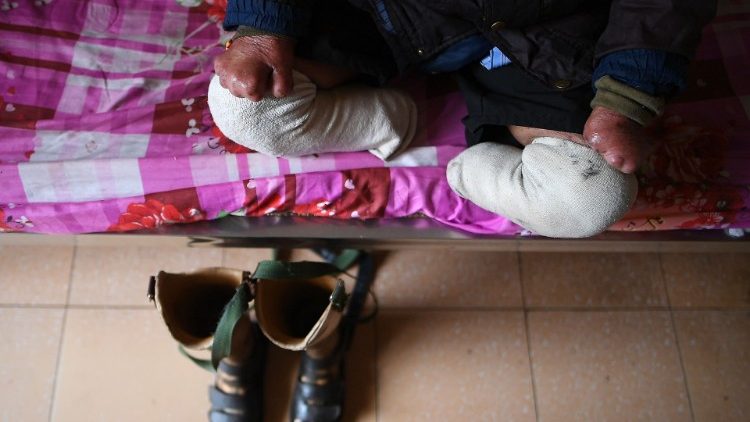
Vatican urges fight against stigma, discrimination and prejudice of leprosy A person with Hansen's disease.

Cardinal Peter Turkson, the Prefect of the Vatican Dicastery for Promoting Integral Human Development, released a message on the occasion of 66th World Leprosy Day, marked on Sunday, January 27.
By Robin Gomes
The Vatican is urging the international community not only to help eliminate Hansen’s disease but also to end the stigma, discrimination and prejudice attached to it by treating those hit by it with love, compassion and solidarity.
Cardinal Peter Turkson, the Prefect of the Dicastery for Promoting Integral Human Development, made the call in a message on the occasion of 66th World Leprosy Day, marked on Sunday, January 27.
“The theme for this year’s World Leprosy Day, “Ending discrimination, stigma, and prejudice,” teaches us clearly that one of the most critical needs in the lives of those experiencing this devastating disease is love,” the cardinal wrote.
He noted that over 200,000 new cases of Hansen’s disease or leprosy are reported annually, with 94% of them in 13 countries, striking especially the neediest and poorest people.  Hence, as Pope Francis said, it is important to keep solidarity alive with these brothers and sisters who are disabled as a result of this disease.

Love and compassion

Even though the multidrug therapy (MDT) and skilled clinical service have proven effective in addressing this illness, Card. Turkson noted, “no institution can by itself replace the human heart or human compassion when it is a matter of encountering the suffering of another.”
The Ghanaian cardinal the cited the approach of Jesus, the Divine Physician, who heals not from a distance but by drawing near, coming in direct contact with and touching the person with leprosy. 
As models of this, he pointed to the 19th century St. Damien de Veuster of Molokai and St. Francis of Assisi who cared for and kissed the person with leprosy.  Both of them saw in the lepers the figure of Christ crucified.  “Every true encounter,” the cardinal said, “has the power to restore life and hope.”
Card. Turkson urged the fight against Hansen’s disease and the stigma, discrimination and prejudice attached to it, by cooperating and collaborating with government agencies and NGOs in helping the complete integration of the person in all of his or her bodily and spiritual dimensions.

Pope at Mass: Priests should be joyful, like St John Bosco

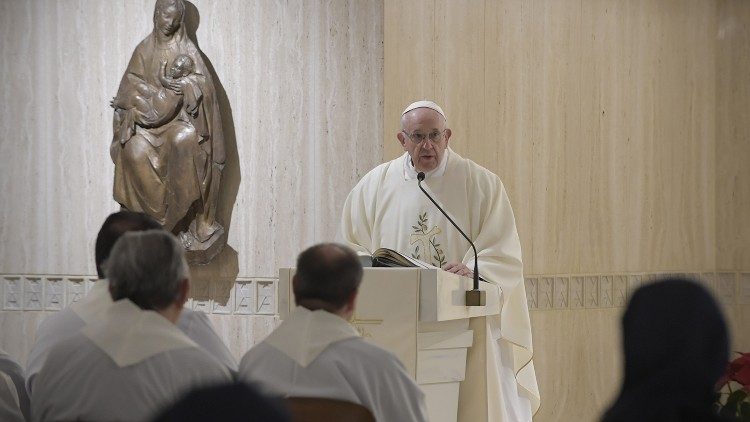
Pope at Mass: Priests should be joyful, like St John Bosco 2019.01.31  Messa Santa Marta

Pope Francis reflects on St John Bosco for the Saint’s feast day. Priests, he says, should have the courage to see people with the human eyes and with the eyes of God.
By Debora Donnini
Priests should be joyful and see things from both a human and a divine perspective, as St John Bosco did. That was Pope Francis’ message during Thursday’s Mass at the Casa Santa Marta. He encouraged priests to imitate Don Bosco, who looked upon reality with the heart of a father and of a teacher, as we read in the opening prayer. It was a perspective that showed him the way forward: he was moved at the sight of the poor young boys in the streets, and looked for ways to help them grow. He walked with them, and he wept with them.

Seeing with human eyes and the eyes of God

Pope Francis recalled that on the day of his ordination, Don Bosco’s mother – a humble woman of the land, “who had never studied in the faculty of theology” – said to him: “Today you will begin to suffer.” She wanted to emphasize a reality, but also catch his attention; because if her son did not recognize suffering, it would mean things were not going well. “It is a prophecy of a mother,” the Pope said. For a priest, then, suffering is a sign that things are going well – not because he is acting the part of “a fakir”, but because he has the courage, like St John Bosco, to look upon reality with the human eyes and with the eyes of God. In a “masonic age,” an age of “priest-eaters”, he saw “a closed-off aristocracy, where the poor were really the poor, the discarded, he saw those young boys on the streets and said ‘this cannot be!’”
He saw with the eyes of a man, a man who is a brother but also a father, and he said, “No, things can’t go on like this! These young boys might end up on the gallows, [ministered to] by Don Cafasso… no, things can’t go on like this.” And he was moved as a man, and as a man he began to think of ways to raise the youngsters, to make the young boys grow. Human paths. And then, he had the courage to see with the eyes of God, and to go to God and say, “Make me see this… this is an injustice… how do I deal with this… You have created these people for a fullness, and they are in the midst of a real tragedy…” And so, seeing reality with the love of a father – a father and teacher, today’s liturgy says – and seeing God with the eyes of a beggar who asks for light, he began to go forward.
Don Giuseppe Cafasso comforted the prisoners in Turin in the 19th century and often followed those condemned to death to the gallows. He was a great friend of St John Bosco.

A priest close at hand

The priest, then, should have “these two polarities,” the Pope said: “to look upon reality with human eyes,” and with “the eyes of God.” And this means “spending a lot of time before the tabernacle”:
Looking in this way made him see the path, so that he wasn’t going simply with the Catechism and the Crucifix: “Do this…” with the boys saying, “Good night, see you later.” No, no. He drew close to them, with their liveliness. He played games with them, he put them in groups, like brothers. And in this way he went forth, he walked with them. The priest who looks on the people in a human way, who is always at hand.

Not an employee or a functionary

Pope Francis emphasized that priests should not be functionaries, or simply employees with set office hours. “We have plenty of good officials,” he said, “who do their jobs, as officials must. But the priest is not a functionary, he cannot be.” The Pope then called on priests to see with human eyes – and, he promised, “you will receive that sentiment, that wisdom of understanding that they are your children, your brothers and sisters. And then, [you will] have the courage of going out there to fight. The priest is the one who struggles with God.”
The Holy Father acknowledged, “There is always the risk of regarding the human at the expense of the divine, or the divine at the expense of the human.” However, he warned, “if we do not take the risk, we won’t accomplish anything in life.” This certainly entails a degree of suffering; persecution and gossip begin: “See that priest standing there, in the street,” with those poorly behaved children, who “will break my window” with their games.

Don Bosco, teacher of joy

Pope Francis thanked God for the gift of Don Bosco, who began to work as a child, and knew what it meant to earn his bread each day. He understood what true piety was. God gave Don Bosco a great heart, the Pope said in conclusion, the heart of a father and a teacher:
And what is the sign that a priest is doing well, seeing reality with human eyes and with the eyes of God? Joy. When a priest does not find joy within, he should stop immediately and ask himself why. And Don Bosco’s joy is known, eh? Because he made others joyful, and rejoiced himself. And he suffered. Today, let us ask the Lord, through the intercession of Don Bosco, for the grace for our priests to be joyful: joyful so that they have the true sense of looking at things regarding pastoral ministry, the people of God with human eyes and with the eyes of God.

மனிதகுலத்தின் நலனுக்கு எண்ணிமத் தொழில்நுட்பங்கள் சேவை செய்ய வேண்டும்: திருத்தந்தை

  மனிதகுலத்தின் நலனுக்கு எண்ணிமத் தொழில்நுட்பங்கள் சேவை செய்ய வேண்டும்: திருத்தந்தை அனைத்துலக நிர்வாக அறிவியல் கழகத்தின் (IIAS) உறுப்பினர்கள...